

This is what I have and I have it big time. My writing drought has been long and prolonged and strangely, or perhaps not so strangely, started after my gargantuan writing effort at Nanowrimo. It is tempting to think I wrote out everything I had and there is no more.
I have been thinking about our writing group challenge (for Friday) which is to write something inspired by a piece of art, perhaps particularly Christina's world. I have been trying to get enthused enough to cobble something together. This should be easy. Two years ago I would have found the idea interesting and been keen on the challenge. Now I just can't seem to get motivated. I think I just don't want to write small pieces any more, and my inner self has just shut down, refused. A little voice keeps saying "Why are you just fooling around. Buckle down and finish your book."
The same thing happened with my painting. I got tired of going to classes and thinking about painting. I wanted to just PAINT. Not just little excercises but a canvas. Since then I have finished two and I am working on a third. My friend helped keeep me on track by providing goals and a deadline to meet. (Thanks Mamie!)
I know I have some good writing in me, I am not tapped out. It is all there just waiting to bubble out when the time is right. But that time is not now it seems.
Subscribe

 Posts
All Comments
Posts
All Comments
Monday, April 09, 2007


Tuesday, March 27, 2007
Acknowledgements
In my post a month ago I discussed 3 Day Road and my sense or suspicion that the author had got much of the colour and imagery and even little vignettes for his book from other sources which he had not acknowledged. Bernice Morgan in comparison was assiduous in recognising the material that influenced her writing.
In the back of Waiting for Time in her acknowledgements the author writes: "The following is a very incomplete list of books by writers living and dead to whom I am deeply indebted." A list of 18 books and their authors follows. She also specifically adds this thanks: "I want to especially thank Paul O'Neill who kindly gave me permission to use the maid's whipping as described in his book The Oldest City and Isobel Brown for her stories about women who crossed the Atlantic as war brides."
I applaud and respect Bernice for these tips of the hat although one would hope it is the least to be expected of a responsible writer. This has been an issue with me before. I remember particularly John Ralston Saul's book The Unconscious Civilization, a non-fiction effort which made many claims which were unsupported by even minimal references.
In the back of Waiting for Time in her acknowledgements the author writes: "The following is a very incomplete list of books by writers living and dead to whom I am deeply indebted." A list of 18 books and their authors follows. She also specifically adds this thanks: "I want to especially thank Paul O'Neill who kindly gave me permission to use the maid's whipping as described in his book The Oldest City and Isobel Brown for her stories about women who crossed the Atlantic as war brides."
I applaud and respect Bernice for these tips of the hat although one would hope it is the least to be expected of a responsible writer. This has been an issue with me before. I remember particularly John Ralston Saul's book The Unconscious Civilization, a non-fiction effort which made many claims which were unsupported by even minimal references.
Saturday, March 24, 2007
Waiting
Waiting for Time was our last book circle book and it was not at all a bad read. This book was a sequel to Random Passage which had been used as a base of the mini series. What came across most clearly in our discussion was the strength and determination given by the author to her character Mary Bundle which was in some contrast, we thought, to the character of Lav who seemed to drift into situations without much direction .
I have been thinking about this, trying to think about what the author was trying to say. Perhaps she meant to contrast the change in times, how we as a culture have become soft and self indulgent? This fits. Think of the scene on the beach near the end where poor Lav was terrorised by yahoo type young folk on their morotcycles and ATVs. And yet she was also trying to indicate -perhaps- that while times change the strength of the people to adapt is still there? There is the character of Alf in support of that. Or is the determination and strength of Mary a mirage? Was she and her life - as Ned said- just a product of fate and not really in her control at all?
The best part of the book was definitely the central story of Mary and her life on Cape Random with all its hardships and clashes of personality. The contemporary first and end chapters didn't have the same impact.
I have been thinking about this, trying to think about what the author was trying to say. Perhaps she meant to contrast the change in times, how we as a culture have become soft and self indulgent? This fits. Think of the scene on the beach near the end where poor Lav was terrorised by yahoo type young folk on their morotcycles and ATVs. And yet she was also trying to indicate -perhaps- that while times change the strength of the people to adapt is still there? There is the character of Alf in support of that. Or is the determination and strength of Mary a mirage? Was she and her life - as Ned said- just a product of fate and not really in her control at all?
The best part of the book was definitely the central story of Mary and her life on Cape Random with all its hardships and clashes of personality. The contemporary first and end chapters didn't have the same impact.
Sunday, March 11, 2007
Watching writing
Would that be interesting? Somehow I don't think so but someone does and if you do then you should attend this event.
Word nerds, bring your pyjamas and your procrastination. And don’t forget your thesaurus.
Dalhousie University embarks on a unique experiment today designed to expose the usually solitary act of writing.
The event, called Write Here in Plain Sight (the apt acronym is WHIPS), is meant to help students and others witness the actual writing process.
Five professors from Dal will engage in academic writing and one other writer, Chronicle Herald columnist Gail Lethbridge, will exercise her creative writing powers.
"You will see among the six people some very different approaches, and I hope that might encourage students to think through the question of what processes work for them and which ones don’t . . . so they can modify their own writing behaviours to get better outcomes," organizer Sunny Marche, associate dean of graduate studies and a professor of management, said in an interview.
The event, which is open to the general public and goes from 9 a.m. to 3 p.m., will happen in the Scotiabank Auditorium at the Marion McCain Arts and Social Sciences Building on University Avenue and at the Kenneth C. Rowe Management Building up the street.
Each writer will be in one room all day, while onlookers will be free to float among the six rooms. The writer’s words, warts and all, will be displayed on a large screen for the audience. They’re also being asked to do the things they normally would while writing. That includes bringing any accoutrements or items of comfort they usually have at their disposal.
I won't be going. I just don't think I would learn much. I would be better off staying at home and trying to write myself which is something I have had great trouble doing lately.
Tuesday, February 20, 2007
Three Day Road
I am of two minds about this book. I started it and liked it immediately, getting quickly into the story and a third of a way into the book. It had an authenticity in most of the parts dealing with the James Bay Cree and vivid and moving descriptions of WWI trench warfare. The author, Joseph Boyden, had included detailed vignettes which were graphic and human which would be difficult to imagine for someone who had not experienced them himself. Wonderful acheivement I thought for a young and first author. I was impressed.
And then something happened. I read something else that tinged my impression of the book, or rather of the author and affected my evaluation of his work. Let me tell you what happened. My sister, by happenstance just at this time, sent me a detail she had found among my recently deceased great aunt's papers about the death of my great uncle. He died Sept 2, 1918 - so close to the end of the war- and was buried "in the vicinity of Noreuil which is North North East of Bapaume, between Amiens and Cambrai in northern France". So I googled these names hoping to find out what battle his regiment fought on the day he died and came upon an online book written by a WWI war correspondent Phillip Gibb. When I started reading this I was struck by the similarity between this work of non-fiction and the wartime parts of Three Day Road.
Also by happenstance I had just read this piece by Brian Bethune who wrote :
In December it came out (passive voice, because I can’t remember how it came out) that McEwan had found such compelling war-time material in the autobiography of romance novelist Lucilla Andrews, that he used some 450 words of it in his 2001 masterpiece, Atonement. Trouble is he didn’t change much at all, just pulled a quick cut—and—paste job. McEwan was able to shrug it off—he is, after all, probably the world’s greatest English-language novelist. A horde of big-name peers rallied to the cause, fellow lords of creation who adhere to the novelist’s first article of faith: we have the right to utilize as we wish the scribblings of lesser mortals (i.e. non-fiction writers), just as we have the right to play with the lives of real people (at least those who are safely dead and unable to establish lucrative relationships with libel lawyers)
And I so liked Atonement. I went to Boyden's book looking in the back or front for a bibliography or acknowledgement of any research he did. There was very little. He credited one person for help with the northern Cree language, and one WWI historian - R. James Steele ( who will not come up on a Chapters or an Amazon search) and his brother (for attention to military detail). His profile says that his father served in WWII and a grandfather and uncle served in WWI
I am not saying that Boyden lifted Gibbs words but I would be willing to bet that he read Gibbs memoir and picked out many of the images (changing them slightly) and this gave his book that veracity I sensed. What other sources did he use I wonder. Why didn't he mention them? It was obvious that he did a lot of research. How would he know about "duckboards" and "estaminets" unless he had. But more than just little details there was a similarity in the writing, the mood between the two pieces, although I found Gibbs account much more moving as one might expect from a piece that was so highly coloured by emotional memory and profound experience. Here is a small excerpt from Gibbs' first chapter:
In Dixmude young boys of France-- fusiliers marins--lay dead about the Grande Place. In the Town Hall, falling to bits under shell-fire, a colonel stood dazed and waiting for death amid the dead bodies of his men--one so young, so handsome, lying there on his back, with a waxen face, staring steadily at the sky through the broken roof. . . . At Nieuport-les-Bains one dead soldier lay at the end of the esplanade, and a little group of living were huddled under the wall of
a red-brick villa, watching other villas falling like card houses in a town that had been built for love and pretty women and the lucky people of the world. British monitors lying close into shore were answering the German bombardment, firing over Nieuport to the dunes by Ostend. From one monitor came a group of figures with white masks of cotton-wool tipped with wet blood. British seamen, and all blind, with the dead body of an officer tied up in a sack . . . .
"O Jesu! . . . O maman! . . . O ma pauvre p'tite femme! . . . O Jesu! O Jesu!"
From thousands of French soldiers lying wounded or parched in the burning sun before the battle of the Marne these cries went up to the blue sky of France in August of '14. They were the cries of youth's agony in war. Afterward I went across the fields where they fought and saw their bodies and their graves, and the proof of the victory that saved France and us. The German dead had been gathered into heaps like autumn leaves. They were soaked in petrol and oily smoke was rising from them . . . .
And a little further on:
In the very early days we lived in a small old house, called by courtesy a chateau, in the village of Tatinghem, near General Headquarters at St.-Omer. (Afterward we shifted our quarters from time to time, according to the drift of battle and our convenience.) It was very peaceful there amid fields of standing corn, where peasant women worked while their men were fighting, but in the motor-cars supplied us by the army (with military drivers, all complete) it was a quick ride over Cassel Hill to the edge of the Ypres salient and the farthest point where any car could go without being seen by a watchful enemy and blown to bits at a signal to the guns. Then we walked, up sinister roads, or along communication trenches, to the fire-step in the front line, or into places like "Plug Street" wood and Kemmel village, and the ruins of Vermelles, and the lines by Neuve Chapelle-- the training-schools of British armies--where always birds of death were on the wing, screaming with high and rising notes before coming to earth with the cough that killed. . . After hours in those hiding- places where boys of the New Army were learning the lessons of war in dugouts and ditches under the range of German guns, back again to the little white chateau at Tatinghem, with a sweet scent of flowers from the fields, and nightingales singing in the woods and a bell tinkling for Benediction in the old church tower beyond our gate.
I would like to read some of Gibbs other book, also online, titled The Soul of the War. And I would like to re-read 3 Day Road and pick out the parts which compare to Gibbs memoire and put them side by side. I might just do that.
And then something happened. I read something else that tinged my impression of the book, or rather of the author and affected my evaluation of his work. Let me tell you what happened. My sister, by happenstance just at this time, sent me a detail she had found among my recently deceased great aunt's papers about the death of my great uncle. He died Sept 2, 1918 - so close to the end of the war- and was buried "in the vicinity of Noreuil which is North North East of Bapaume, between Amiens and Cambrai in northern France". So I googled these names hoping to find out what battle his regiment fought on the day he died and came upon an online book written by a WWI war correspondent Phillip Gibb. When I started reading this I was struck by the similarity between this work of non-fiction and the wartime parts of Three Day Road.
Also by happenstance I had just read this piece by Brian Bethune who wrote :
In December it came out (passive voice, because I can’t remember how it came out) that McEwan had found such compelling war-time material in the autobiography of romance novelist Lucilla Andrews, that he used some 450 words of it in his 2001 masterpiece, Atonement. Trouble is he didn’t change much at all, just pulled a quick cut—and—paste job. McEwan was able to shrug it off—he is, after all, probably the world’s greatest English-language novelist. A horde of big-name peers rallied to the cause, fellow lords of creation who adhere to the novelist’s first article of faith: we have the right to utilize as we wish the scribblings of lesser mortals (i.e. non-fiction writers), just as we have the right to play with the lives of real people (at least those who are safely dead and unable to establish lucrative relationships with libel lawyers)
And I so liked Atonement. I went to Boyden's book looking in the back or front for a bibliography or acknowledgement of any research he did. There was very little. He credited one person for help with the northern Cree language, and one WWI historian - R. James Steele ( who will not come up on a Chapters or an Amazon search) and his brother (for attention to military detail). His profile says that his father served in WWII and a grandfather and uncle served in WWI
I am not saying that Boyden lifted Gibbs words but I would be willing to bet that he read Gibbs memoir and picked out many of the images (changing them slightly) and this gave his book that veracity I sensed. What other sources did he use I wonder. Why didn't he mention them? It was obvious that he did a lot of research. How would he know about "duckboards" and "estaminets" unless he had. But more than just little details there was a similarity in the writing, the mood between the two pieces, although I found Gibbs account much more moving as one might expect from a piece that was so highly coloured by emotional memory and profound experience. Here is a small excerpt from Gibbs' first chapter:
In Dixmude young boys of France-- fusiliers marins--lay dead about the Grande Place. In the Town Hall, falling to bits under shell-fire, a colonel stood dazed and waiting for death amid the dead bodies of his men--one so young, so handsome, lying there on his back, with a waxen face, staring steadily at the sky through the broken roof. . . . At Nieuport-les-Bains one dead soldier lay at the end of the esplanade, and a little group of living were huddled under the wall of
a red-brick villa, watching other villas falling like card houses in a town that had been built for love and pretty women and the lucky people of the world. British monitors lying close into shore were answering the German bombardment, firing over Nieuport to the dunes by Ostend. From one monitor came a group of figures with white masks of cotton-wool tipped with wet blood. British seamen, and all blind, with the dead body of an officer tied up in a sack . . . .
"O Jesu! . . . O maman! . . . O ma pauvre p'tite femme! . . . O Jesu! O Jesu!"
From thousands of French soldiers lying wounded or parched in the burning sun before the battle of the Marne these cries went up to the blue sky of France in August of '14. They were the cries of youth's agony in war. Afterward I went across the fields where they fought and saw their bodies and their graves, and the proof of the victory that saved France and us. The German dead had been gathered into heaps like autumn leaves. They were soaked in petrol and oily smoke was rising from them . . . .
And a little further on:
In the very early days we lived in a small old house, called by courtesy a chateau, in the village of Tatinghem, near General Headquarters at St.-Omer. (Afterward we shifted our quarters from time to time, according to the drift of battle and our convenience.) It was very peaceful there amid fields of standing corn, where peasant women worked while their men were fighting, but in the motor-cars supplied us by the army (with military drivers, all complete) it was a quick ride over Cassel Hill to the edge of the Ypres salient and the farthest point where any car could go without being seen by a watchful enemy and blown to bits at a signal to the guns. Then we walked, up sinister roads, or along communication trenches, to the fire-step in the front line, or into places like "Plug Street" wood and Kemmel village, and the ruins of Vermelles, and the lines by Neuve Chapelle-- the training-schools of British armies--where always birds of death were on the wing, screaming with high and rising notes before coming to earth with the cough that killed. . . After hours in those hiding- places where boys of the New Army were learning the lessons of war in dugouts and ditches under the range of German guns, back again to the little white chateau at Tatinghem, with a sweet scent of flowers from the fields, and nightingales singing in the woods and a bell tinkling for Benediction in the old church tower beyond our gate.
I would like to read some of Gibbs other book, also online, titled The Soul of the War. And I would like to re-read 3 Day Road and pick out the parts which compare to Gibbs memoire and put them side by side. I might just do that.
Tuesday, January 23, 2007
Another foray into non-fiction
I like more non-fiction as I age. I almost always have one on the go in the stack by my bed. The last one I read before this was A Short History of Nearly Everything by Bill Bryson. It's a great book for people who are interested in science as I am, although it is not really about the science but about the scientists, their flawed humanity, and how science is viewed or scorned or ignored or twisted by society- humans again. So it was a very human book and humourous too.
But now I am reading a book about a politician. My science interest apart, my field of study way back when was political science and history and then international affairs. I have a collection of books on politicians - Winston Chruchill, Diefenbaker, Pearson (I took a course from him at Carleton), Trudeau, Chretien, to name a few.
I probably should be reading Johnson's Stephen Harper and the Future of Canada but this one is Stephen Harper, the Case for Collaborative Governance by Lloyd Mackey. I have to say that it is not terribly well written. I find it rambling, repetitive and unfocused. But in spite of its literary flaws I am finding it worth reading.
Harper's grandparents came from New Brunswick and he spent some summers there as a boy. He was born and grew up in middle class Toronto, his parents voted Liberal and he was raised United Church (Some people I know would say that was enough to turn anyone off the left) and then Presbyterian when his parents moved. He admired Trudeau. He graduated with a gold medal for highest marks from his high school. He then went to the University of Calgary.
Of special interest to me is Harper's religious bent, painted as he often is in garish religious right colours. This quote was arresting because you can tell a lot about a person from what they read. "Harper had no social background in the turbulent changes occuring in Canadian evangelicalism. His move from scepticism to faith had come through a revisiting of his own religious background with the help of the writings of C.S. Lewis and Malcolm Muggeridge." Huh? Anyone who reads C.S. Lewis seriously can't be all bad. When he went to Ottawa as opposition leader he attended East Gate Alliance church a small evangelical parish in a French working class area. " Besides English the languages of worship are Filipino, Spanish and French."
The author has this to say about faith in politics and Martin (who attended Blessed Sacrament Church, a large charismatic RC parish in Ottawa) and Harper: "Both men could be considered 'customising' Christians... Customising Christians attend church fairly frequently but not because they feel they need to. They listen pretty carefully to their pastors but they do not necessarily take the word of those pastors as ultimate truth. Positively stated they are critical thinkers. They appreciate what the pastor has to say but they use the minds God gave them as well.... Customising Catholics show up in similar proportions....People who try to detract from Martin's or Harper's faiths are doing no justice to the political process." A little further on the author notes: "It was not until after his death that the public became aware of Trudeau's spiritual commitment and discipline within the framework of Catholic thought."
Here's another comment: "There was another religious factor that Harper had to face, in the form of the "social gospel" which had been at the base of Douglas's New Democratic Party and its predecessor. If the various evangelical denominations represented the "Conservatives at prayer" much the same thing could be said of the United Church -especially its more liberal social justice wing. It was like "the NDP at prayer".... Harper gradually formed the conclusion that mainstream Protestant leaders in their embrace of the social gospel and more particularly liberation theology, were becoming more Marxist and less Christian." Hmmm. "In that sentiment, he probably found considerable agreement from Malcolm Muggeridge, who when converted to Christianity, jumped straight across the religio-political spectrum from left to right." I am going to have to read some Muggeridge. The author interviewed Muggeridge once the results of which were never published. He says: "It was a bit of a barn-burner in its critique of the contemporary liberal church which he believed was thoroughly apostate and corrupt. "
Harper is described as a voracious reader. He apparently asked his thesis advisor which classic economics texts he should read. His advisor told him he didn't have to read them, no one else did . But Harper did anyway and his bibliography ran to 10 pages plus 2 pages of other sources.
There is a really good analysis of Harper's speech to the Fraser Institute in Calgary April 29 2005 which reveals a lot about his policy direction. Lots of good stuff to mull over. He is our Prime Minister. After reading this book I know more about him now than I did and am less likely to be swayed by political hyperbole on either side.
But now I am reading a book about a politician. My science interest apart, my field of study way back when was political science and history and then international affairs. I have a collection of books on politicians - Winston Chruchill, Diefenbaker, Pearson (I took a course from him at Carleton), Trudeau, Chretien, to name a few.
I probably should be reading Johnson's Stephen Harper and the Future of Canada but this one is Stephen Harper, the Case for Collaborative Governance by Lloyd Mackey. I have to say that it is not terribly well written. I find it rambling, repetitive and unfocused. But in spite of its literary flaws I am finding it worth reading.
Harper's grandparents came from New Brunswick and he spent some summers there as a boy. He was born and grew up in middle class Toronto, his parents voted Liberal and he was raised United Church (Some people I know would say that was enough to turn anyone off the left) and then Presbyterian when his parents moved. He admired Trudeau. He graduated with a gold medal for highest marks from his high school. He then went to the University of Calgary.
Of special interest to me is Harper's religious bent, painted as he often is in garish religious right colours. This quote was arresting because you can tell a lot about a person from what they read. "Harper had no social background in the turbulent changes occuring in Canadian evangelicalism. His move from scepticism to faith had come through a revisiting of his own religious background with the help of the writings of C.S. Lewis and Malcolm Muggeridge." Huh? Anyone who reads C.S. Lewis seriously can't be all bad. When he went to Ottawa as opposition leader he attended East Gate Alliance church a small evangelical parish in a French working class area. " Besides English the languages of worship are Filipino, Spanish and French."
The author has this to say about faith in politics and Martin (who attended Blessed Sacrament Church, a large charismatic RC parish in Ottawa) and Harper: "Both men could be considered 'customising' Christians... Customising Christians attend church fairly frequently but not because they feel they need to. They listen pretty carefully to their pastors but they do not necessarily take the word of those pastors as ultimate truth. Positively stated they are critical thinkers. They appreciate what the pastor has to say but they use the minds God gave them as well.... Customising Catholics show up in similar proportions....People who try to detract from Martin's or Harper's faiths are doing no justice to the political process." A little further on the author notes: "It was not until after his death that the public became aware of Trudeau's spiritual commitment and discipline within the framework of Catholic thought."
Here's another comment: "There was another religious factor that Harper had to face, in the form of the "social gospel" which had been at the base of Douglas's New Democratic Party and its predecessor. If the various evangelical denominations represented the "Conservatives at prayer" much the same thing could be said of the United Church -especially its more liberal social justice wing. It was like "the NDP at prayer".... Harper gradually formed the conclusion that mainstream Protestant leaders in their embrace of the social gospel and more particularly liberation theology, were becoming more Marxist and less Christian." Hmmm. "In that sentiment, he probably found considerable agreement from Malcolm Muggeridge, who when converted to Christianity, jumped straight across the religio-political spectrum from left to right." I am going to have to read some Muggeridge. The author interviewed Muggeridge once the results of which were never published. He says: "It was a bit of a barn-burner in its critique of the contemporary liberal church which he believed was thoroughly apostate and corrupt. "
Harper is described as a voracious reader. He apparently asked his thesis advisor which classic economics texts he should read. His advisor told him he didn't have to read them, no one else did . But Harper did anyway and his bibliography ran to 10 pages plus 2 pages of other sources.
There is a really good analysis of Harper's speech to the Fraser Institute in Calgary April 29 2005 which reveals a lot about his policy direction. Lots of good stuff to mull over. He is our Prime Minister. After reading this book I know more about him now than I did and am less likely to be swayed by political hyperbole on either side.
Tuesday, January 16, 2007
Saving Fish
Ah, good intentions. The Burma Road is paved with them in Amy Tan's Saving Fish from Drowning. This is a book about illusions and unintended consequences. It is about lies we tell ourselves, lies we tell each other, and lies told to us. Life turned into a reality show. Survivor Burma.
The title is the clue to this main theme. We justify our actions as doing good for others -saving the fish - but so very often, whether intentionally or unintentionally we are self serving- fishing for ourselves. In the interview with the author in the Reader's guide at the back Tan answers a question about blurring fact and fiction with this response: "Which kind of fiction is most harmful : the fiction masquerading as truth or the fiction that contains truth?"
I love Tan's acerbic, politically incorrect narrator, Bibi Chen. Through her eyes we see cross cultural confusion and clash of cultures and religions, media spin, government corruption genocide and oppression, all laced with witty commentary and irony.
There are some good shots -via Bibi- at the shallowness of the media, the eagerness to use and be used, for the sake of a good story.
"The worst of the newshounds in my opinion was Philip Gutman of Free to Speak International. That megalomaniac contacted GNN and dangled bait in front of them and they bit... he was proud that a member of Free to Speak was among the missing. He added in dramatic fashion that this person has now joined the tens of thousands of people now missing in Burma." ... Naturally this led to a flurry of guesses about who this activist might be... Who was the troublemaker they wanted to know... The punishment for spies in Mayanmar was similar to that for people who were caught smuggling drugs: death. Wendy may have been an immature nitwit but that did not mean she deserved to have her head lopped off simply because her former housemate seized any opportunity to promote his cause. " ...
This book is laugh out loud funny in places, black humour sometimes but mostly based on human behavior and foibles-which Tan makes clear is not a function of just one ideology, religion or culture. A policeman asks a Burmese witness who claims to have seen the missing tourists: "Did you see them before or after they disappeared?" How many times have we seen a reporter ask a similar silly question for the camera.
The GNN bureau chief in Bangkok coordinated with headquarters in New York on interviews. At the Bangkok airport, reporters from GNN and other media outlets swarmed the tourists arriving from Mandalay and Rangoon. Had they been frightened? Did they leave early? Would they ever go back? The people from New York and Rio de Janeiro gave wearied and disgusted looks as they pushed past... But a few travelers were easily stopped, because they were from some cities like Indianapolis, Indiana or Manchester, England where is it was considered rude not to acknowledge someone who asked you a question. Those from Los Angelos also willingly stepped before the camera since it was their civil right. " It was so hard to spend time in a country" a woman from Studio City commented "where eleven people wind up dead. "She was reminded that no one was confirmed deceased so she added , "Well it still gets to you."
"Were you scared" a reporter shouted to a couple emerging from a set of doors. "This one was" said a sunburned man, in a flat tone, and he jerked his thumb toward a woman behind him. "She went hysterical." The woman gave him a smile of annoyance. She turned to the reporter and said, her stony smile still affixed. "To be honest I was more concerned we'd get stuck if they shut down the airports." Her response - plus that gritted smile meant for her husband- was replayed each hour, making it seem to millions of people that she was a coldhearted bitch.
There are lots of moral morsels to chew on.
"I'd be uncomfortable," she said, "putting them [their abductors] at risk."
"But we're already uncomfortable, "Dwight retorted. And we are at risk. Don't you realize where we are. We're in the f---ing jungle. We already had malaria. What's next? Snakebite? Typhus? When do we factor us into the equation for what we do."
He had brought up their unspoken worries and a series of morally ugly questions. Whom do you save? Can you save both? Or do you save only yourself? Do you do nothing and risk nothing or die from whatever happens to come along as you sit on a log waiting for whatever comes?"
And further on: "But how did you know whether your intention would help, or whether it would only lead to worse problems? Sanctions or engagement? How could anyone know what approach would work? Who could guarantee it? And if it failed, who suffered the consequences? Who took responsibility? Who would undo the mess? Would anyone be around to care? No one had any answers...."
And some lyrically beautiful passages:
"With the Mind of Others I could see where they [The Karen] were. There is a place in the jungle called Somewhere Else, a split that divides Life from Death, and it is darker and deeper than the other ravine. They lie on their mats, all in a row, and they stare at the tree canopy that hides the sky. When the sun is gone and there a4e no stars above, they turn to their memory. They hear a hundred bronze drums, a hundred cow horns, a hundred wood gourds in the shape of frogs. They hear flutes chirp and bells echo. They hear the gurgling brook music any god would love. Together they sing in perfect harmony. We are together and that is what matters."
There are two kind of books in my estimation. Ones you know you will reread some day and those you know you won't. The first I keep, the second I eventually get rid of. Saving Fish has much to say in its wacky way and it is a keeper.
The title is the clue to this main theme. We justify our actions as doing good for others -saving the fish - but so very often, whether intentionally or unintentionally we are self serving- fishing for ourselves. In the interview with the author in the Reader's guide at the back Tan answers a question about blurring fact and fiction with this response: "Which kind of fiction is most harmful : the fiction masquerading as truth or the fiction that contains truth?"
I love Tan's acerbic, politically incorrect narrator, Bibi Chen. Through her eyes we see cross cultural confusion and clash of cultures and religions, media spin, government corruption genocide and oppression, all laced with witty commentary and irony.
There are some good shots -via Bibi- at the shallowness of the media, the eagerness to use and be used, for the sake of a good story.
"The worst of the newshounds in my opinion was Philip Gutman of Free to Speak International. That megalomaniac contacted GNN and dangled bait in front of them and they bit... he was proud that a member of Free to Speak was among the missing. He added in dramatic fashion that this person has now joined the tens of thousands of people now missing in Burma." ... Naturally this led to a flurry of guesses about who this activist might be... Who was the troublemaker they wanted to know... The punishment for spies in Mayanmar was similar to that for people who were caught smuggling drugs: death. Wendy may have been an immature nitwit but that did not mean she deserved to have her head lopped off simply because her former housemate seized any opportunity to promote his cause. " ...
This book is laugh out loud funny in places, black humour sometimes but mostly based on human behavior and foibles-which Tan makes clear is not a function of just one ideology, religion or culture. A policeman asks a Burmese witness who claims to have seen the missing tourists: "Did you see them before or after they disappeared?" How many times have we seen a reporter ask a similar silly question for the camera.
The GNN bureau chief in Bangkok coordinated with headquarters in New York on interviews. At the Bangkok airport, reporters from GNN and other media outlets swarmed the tourists arriving from Mandalay and Rangoon. Had they been frightened? Did they leave early? Would they ever go back? The people from New York and Rio de Janeiro gave wearied and disgusted looks as they pushed past... But a few travelers were easily stopped, because they were from some cities like Indianapolis, Indiana or Manchester, England where is it was considered rude not to acknowledge someone who asked you a question. Those from Los Angelos also willingly stepped before the camera since it was their civil right. " It was so hard to spend time in a country" a woman from Studio City commented "where eleven people wind up dead. "She was reminded that no one was confirmed deceased so she added , "Well it still gets to you."
"Were you scared" a reporter shouted to a couple emerging from a set of doors. "This one was" said a sunburned man, in a flat tone, and he jerked his thumb toward a woman behind him. "She went hysterical." The woman gave him a smile of annoyance. She turned to the reporter and said, her stony smile still affixed. "To be honest I was more concerned we'd get stuck if they shut down the airports." Her response - plus that gritted smile meant for her husband- was replayed each hour, making it seem to millions of people that she was a coldhearted bitch.
There are lots of moral morsels to chew on.
"I'd be uncomfortable," she said, "putting them [their abductors] at risk."
"But we're already uncomfortable, "Dwight retorted. And we are at risk. Don't you realize where we are. We're in the f---ing jungle. We already had malaria. What's next? Snakebite? Typhus? When do we factor us into the equation for what we do."
He had brought up their unspoken worries and a series of morally ugly questions. Whom do you save? Can you save both? Or do you save only yourself? Do you do nothing and risk nothing or die from whatever happens to come along as you sit on a log waiting for whatever comes?"
And further on: "But how did you know whether your intention would help, or whether it would only lead to worse problems? Sanctions or engagement? How could anyone know what approach would work? Who could guarantee it? And if it failed, who suffered the consequences? Who took responsibility? Who would undo the mess? Would anyone be around to care? No one had any answers...."
And some lyrically beautiful passages:
"With the Mind of Others I could see where they [The Karen] were. There is a place in the jungle called Somewhere Else, a split that divides Life from Death, and it is darker and deeper than the other ravine. They lie on their mats, all in a row, and they stare at the tree canopy that hides the sky. When the sun is gone and there a4e no stars above, they turn to their memory. They hear a hundred bronze drums, a hundred cow horns, a hundred wood gourds in the shape of frogs. They hear flutes chirp and bells echo. They hear the gurgling brook music any god would love. Together they sing in perfect harmony. We are together and that is what matters."
There are two kind of books in my estimation. Ones you know you will reread some day and those you know you won't. The first I keep, the second I eventually get rid of. Saving Fish has much to say in its wacky way and it is a keeper.
Tuesday, January 02, 2007
No New Years resolutions for me
I have resolutions every other day and I don't do any better on those than I do on the ones I make Dec. 31 so I have pretty much given up on New Years resolutions. Which doesn't mean I don't have them. I guess I will just continue to resolve things - like post more on this blog!- and fail or not fail to some degree with them. I might change my blog template if I can figure out how. A new look for a new year might not be a bad thing.
Wednesday, December 27, 2006
That's a relief!
I thought I was just disorganised but no, I'm creative! My desk tells me so.
...January is now Get Organized Month, thanks also to the efforts of the National Association of Professional Organizers, whose 4,000 clutter-busting members will be poised, clipboards and trash bags at the ready, to minister to the 10,000 clutter victims the association estimates will be calling for its members’ services just after the new year. But contrarian voices can be heard in the wilderness. An anti-anticlutter movement is afoot, one that says yes to mess and urges you to embrace your disorder. Studies are piling up that show that messy desks are the vivid signatures of people with creative, limber minds...source
...January is now Get Organized Month, thanks also to the efforts of the National Association of Professional Organizers, whose 4,000 clutter-busting members will be poised, clipboards and trash bags at the ready, to minister to the 10,000 clutter victims the association estimates will be calling for its members’ services just after the new year. But contrarian voices can be heard in the wilderness. An anti-anticlutter movement is afoot, one that says yes to mess and urges you to embrace your disorder. Studies are piling up that show that messy desks are the vivid signatures of people with creative, limber minds...source
Thursday, December 21, 2006
I haven't been writing
I haven't been writing. I feel dry as dust word-wise. I didn't win Nanwrimo this year. I got a few thousand words done and then gave up. I just didn't have the focus this year. They do say the second year is the hardest but I am not happy about it.
I haven't been reading that much either. I haven't even commented on our last book circle book which was My Sister's Keeper by Jodi Picoult.
We did have a good discussion. There was much to think about. You can read a synopsis elsewhere. Of more interest is perhaps the opininon expressed by our little group. It was a while ago but my memory of the consensus was that once you embark on this kind of "experiment" the resulting drama and moral conundrums are inevitable. Guilt, resentment of the favoured child, a feeling of being used or being left out all natural outcomes. Moral of the story: Don't take that first step. Perhaps though I remember that as the consensus when in fact it was only my opinion.
I can't avoid making a moral judgement about this fictional couple. How did they make the decision to engineer a child? What were they thinking? Did they look down the road? Did they think at all about the unborn child? Did they think about their son who seems to have been left out of the equation? Where was their sense of responsibility? Given they did what they did the rest followed like sunset after sunrise. So many people now think in such short term.
I have to applaud the author for attempting the subject. I would like to see the issue handled by more skilful hands but hey.... I can't squeeze out 50,000 coherent words myself .
I haven't been reading that much either. I haven't even commented on our last book circle book which was My Sister's Keeper by Jodi Picoult.
We did have a good discussion. There was much to think about. You can read a synopsis elsewhere. Of more interest is perhaps the opininon expressed by our little group. It was a while ago but my memory of the consensus was that once you embark on this kind of "experiment" the resulting drama and moral conundrums are inevitable. Guilt, resentment of the favoured child, a feeling of being used or being left out all natural outcomes. Moral of the story: Don't take that first step. Perhaps though I remember that as the consensus when in fact it was only my opinion.
I can't avoid making a moral judgement about this fictional couple. How did they make the decision to engineer a child? What were they thinking? Did they look down the road? Did they think at all about the unborn child? Did they think about their son who seems to have been left out of the equation? Where was their sense of responsibility? Given they did what they did the rest followed like sunset after sunrise. So many people now think in such short term.
I have to applaud the author for attempting the subject. I would like to see the issue handled by more skilful hands but hey.... I can't squeeze out 50,000 coherent words myself .
Friday, November 10, 2006
Playing Hooky
I should have been home writing my 2000 words. Instead I went to a movie. BUT it was a good movie for a wannbe writer to see - Stranger than Fiction which is based on a premise I actually used in one of the short pieces I wrote a couple of years ago, that is, an author who writes and his stories come true.
In this movie the author's main protaganist, Harold, an IRS auditor, becomes aware that he is a character in a book and that his creator is trying to bump him off. ( Why didn't I think of that!) Emma Thompson does a great job as the tortured writer with writer's block trying to figure out how to kill her hero. Dustin Hoffman plays an English prof who helps Harold find out who is directing his life and probably his death. There is a love interest for Harold and we, the viewers, get very attached to Harold and his life and don't want to see him die.
I won't spoil the ending for you as I recommend you go see this tragi-comic movie. It is better than the usual fluff you see on the screen these days. Now I should be inspired to write deathless purple prose shouldn't I? Well I should try anyway. I am way, way behind on my count.
In this movie the author's main protaganist, Harold, an IRS auditor, becomes aware that he is a character in a book and that his creator is trying to bump him off. ( Why didn't I think of that!) Emma Thompson does a great job as the tortured writer with writer's block trying to figure out how to kill her hero. Dustin Hoffman plays an English prof who helps Harold find out who is directing his life and probably his death. There is a love interest for Harold and we, the viewers, get very attached to Harold and his life and don't want to see him die.
I won't spoil the ending for you as I recommend you go see this tragi-comic movie. It is better than the usual fluff you see on the screen these days. Now I should be inspired to write deathless purple prose shouldn't I? Well I should try anyway. I am way, way behind on my count.
Thursday, November 02, 2006
Call me Crazy
I am too. But I have signed up for NaNoWriMo again. And I am late so I am already "down" over 3000 words. But ... here I go again aiming for another 50,000 words. Will I get there this year? They say the second year is the hardest. I can believe that. But one foot in front of the other, bird by bird... that's the way to get there. Anybody want to join me?
Sunday, October 22, 2006
late on Saturday
I've been away for a couple of days with other things on my mind. I had hoped to get my thoughts on Saturday down before I left, while they were fresh in my mind but I found that there was so much to say that I couldn't possibly manage it.
But I must say something about Saturday.
It is one of the best books I have read so far this year.
It is dense but readable. The author has a lot to say and he says it well, without preaching. His characters are everyman, maintaining the complexity of humanity, exposing human weaknesses and contradictions.
Without reminding me in any way Atonement, one of McEwan's earlier works, it has all those qualities that made that a great book - good story, well drawn, authentic characters, clear, unpretentious descriptive writing.
McEwan places his protaganist Henry, an ultra-rational neurosurgeon, within a largely artistic family and logs his reactions to an often irrational (familiar and real) world of terrorists, peace marches, petty crime and medical tragedy putting us into his head for one pivotal day in his life, a specific day in Feb. 2003. The villian of the piece, Baxter, who ultimately threatens Henry's comfortable life and family is someone we are tempted to be sympathetic to because of his medical condition and social deprivation.
The book raises moral questions. Is violence ever justified? It is easier to ignore or minimise distant threats but when they come close one's reactions seem clearer. If violence is needed when it threatens you personally can you extend that strategy to the international scene? Does art trump reason? Can poetry reach the irrational and divert them from violence where reason or force cannot- as the poem diverted Baxter away from his intended violence? Where does responsibility begin and end? Henry in a way drew the dangerous Baxter to him and his family by his earlier actions. The novel ends with Henry and his family safe and Baxter's life in his hands. But Henry does not take revenge and instead tries to pick up the messy pieces left from a situation he had played a role in creating.
When they're feeling abandoned in the dark, people could do worse than cling to one another. McEwan's novel ends with the hard-won virtues of forgiveness, familial love, and decency. It's not the grace found at the end of "Atonement," but there's something moving in the fact that Henry always can be counted on to do the decent thing. [source]
I notice that Saturday is # 2 on this list: 1001 books to read before you die.
Interesting also that my the book my friend Mamie raved about, Never Let me Go, is #1!
Looking over the list I see I have managed to read only about 20 of the first 200 on the list and about 33 of the first 300 so extrapolating on this basis I probably have about 90% of the 1001 left to read!!
But I must say something about Saturday.
It is one of the best books I have read so far this year.
It is dense but readable. The author has a lot to say and he says it well, without preaching. His characters are everyman, maintaining the complexity of humanity, exposing human weaknesses and contradictions.
Without reminding me in any way Atonement, one of McEwan's earlier works, it has all those qualities that made that a great book - good story, well drawn, authentic characters, clear, unpretentious descriptive writing.
McEwan places his protaganist Henry, an ultra-rational neurosurgeon, within a largely artistic family and logs his reactions to an often irrational (familiar and real) world of terrorists, peace marches, petty crime and medical tragedy putting us into his head for one pivotal day in his life, a specific day in Feb. 2003. The villian of the piece, Baxter, who ultimately threatens Henry's comfortable life and family is someone we are tempted to be sympathetic to because of his medical condition and social deprivation.
The book raises moral questions. Is violence ever justified? It is easier to ignore or minimise distant threats but when they come close one's reactions seem clearer. If violence is needed when it threatens you personally can you extend that strategy to the international scene? Does art trump reason? Can poetry reach the irrational and divert them from violence where reason or force cannot- as the poem diverted Baxter away from his intended violence? Where does responsibility begin and end? Henry in a way drew the dangerous Baxter to him and his family by his earlier actions. The novel ends with Henry and his family safe and Baxter's life in his hands. But Henry does not take revenge and instead tries to pick up the messy pieces left from a situation he had played a role in creating.
When they're feeling abandoned in the dark, people could do worse than cling to one another. McEwan's novel ends with the hard-won virtues of forgiveness, familial love, and decency. It's not the grace found at the end of "Atonement," but there's something moving in the fact that Henry always can be counted on to do the decent thing. [source]
I notice that Saturday is # 2 on this list: 1001 books to read before you die.
Interesting also that my the book my friend Mamie raved about, Never Let me Go, is #1!
Looking over the list I see I have managed to read only about 20 of the first 200 on the list and about 33 of the first 300 so extrapolating on this basis I probably have about 90% of the 1001 left to read!!
Saturday, October 14, 2006
Getaway wrap up
We just got back from our annual anniversary getaway at our favorite spot. It was a lovely retreat to a riverside chalet with a wood fire to warm us and the sound of the river and a nearby brook to lull us to sleep.
It poured rain on the way up so the fall colours were hidden but the foggy shroud obscuring the hills and trees had its own beauty. The power went off about an hour after we arrived but we didn't really mind. We had a glass of wine by the fire and then headed to the main building for our supper reservation. The menu was restricted by the outage but luckily planked salmon, the specialite de la maison, depended only on an open fire and we enjoyed it just as much or more by candle light. I was almost disappointed when it came back on again a couple of hours later but I suppose I would have got even less reading done if it hadn't.
I hoped to get more done. Perhaps I was too relaxed! I had visions of finishing two books, working on my writing and my painting all the while drinking in the natural beauty of the spot. I was a bit ambitious. I did finish The Double Life of Anna Day but didn't finish Saturday ( and I have to do that before Tuesday's book club meeting! I do want to do it justice as I can see it is a powerful book.) I did work on my painting and probably gave it more time than I should have but I got quite engrossed and the time just flew by. I didn't get any writing done at all. It seems to be the poor sister [ is there a better simile?] and gets left behind in my list.
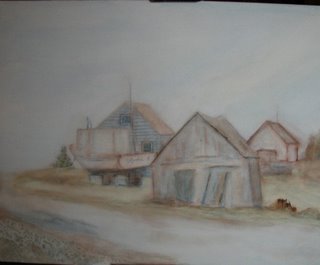
My friend Mamie has posted a photo of one of the painting she has on exhibit at the hospital . Rather than do the same I will post one of the one I am working on, my work in progress. I am only at the underpainting stage but I have high hopes for it.
It poured rain on the way up so the fall colours were hidden but the foggy shroud obscuring the hills and trees had its own beauty. The power went off about an hour after we arrived but we didn't really mind. We had a glass of wine by the fire and then headed to the main building for our supper reservation. The menu was restricted by the outage but luckily planked salmon, the specialite de la maison, depended only on an open fire and we enjoyed it just as much or more by candle light. I was almost disappointed when it came back on again a couple of hours later but I suppose I would have got even less reading done if it hadn't.
I hoped to get more done. Perhaps I was too relaxed! I had visions of finishing two books, working on my writing and my painting all the while drinking in the natural beauty of the spot. I was a bit ambitious. I did finish The Double Life of Anna Day but didn't finish Saturday ( and I have to do that before Tuesday's book club meeting! I do want to do it justice as I can see it is a powerful book.) I did work on my painting and probably gave it more time than I should have but I got quite engrossed and the time just flew by. I didn't get any writing done at all. It seems to be the poor sister [ is there a better simile?] and gets left behind in my list.
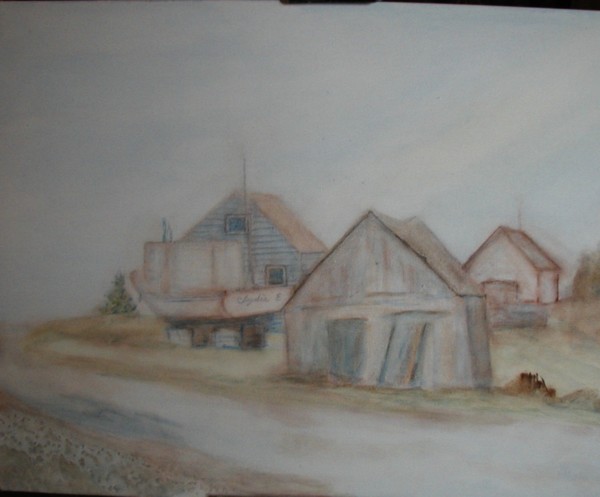
My friend Mamie has posted a photo of one of the painting she has on exhibit at the hospital . Rather than do the same I will post one of the one I am working on, my work in progress. I am only at the underpainting stage but I have high hopes for it.
Saturday, September 30, 2006
Saturday
It is Saturday. A good day to start Saturday by Ian McEwan. I picked it up the other day at Chapters for $10.00 - in hardback! It was the only one on the table so perhaps the last. I have also started The Double Life of Anna Day by Louise Candlish which I am enjoying. It's a Brit book which I tend to like anyway. The author's style reminds me of Lynne Truss somehow but not quite as outlandish - at least not yet. I have some good reading ahead.
Also have been painting and can hardly wait to get back to that as I have started a new canvas based on a photo I took at Blue Rocks. Only wish I had more time for my hobbies!
Also have been painting and can hardly wait to get back to that as I have started a new canvas based on a photo I took at Blue Rocks. Only wish I had more time for my hobbies!
Tuesday, September 26, 2006
Lucy Moon
It has been a while since I have dipped into a book for a "young reader" as they call them. I guess the last Harry Potter book would be the occasion. No, I lie, it would have been His Dark Materials series. But, anyway, I have zipped through That Girl Lucy Moon by Amy Timberlake and can honestly say that this is a book I would have happily bought my daughter - and I was pretty fussy.
Lucy is quirky,brave, believable and also changeable, vulnerable, unsure of herself in her new milieu of middle school. I liked many things about her more than the almost reflexive activism which she wore a bit like her hat as part of her persona. I liked her questioning of things, her desire for truth, her courage, especially the courage to apologise and take her lumps. Yes, I liked Lucy. Not that she didn't have faults but that is what makes her so human, so tangible that you want to just take her in your arms and comfort her as Mrs. Rossignol did.
I also liked the way the author crafted the book. It has young humour. It is spoofy, campy, with names like Turtle Rock and Wiggins, Dee Reams and Mrs. Mudd, a tofu turkey dinner and all the fuss about sledding (but maybe sledding is to Minnesota what hockey is to Port Huron?) Yes, the plot is a bit predictable (historic document proves hill cannot be controlled by Viola Wiggins and therefore free for community sledding after all) but the story really isn't about Wiggins Hill. It is about how Lucy and her Dad get through Lucy's Mom's mid- life crisis, how they grow and how they support each other. That is the real power of the book, the psychological insight it offers.
Lucy is at first sympathetic to and patient with her mother, even proud, but then impatient and annoyed. But as she learns and understands more she becomes angry, bitter, and feels abandoned but in the end she is relieved and reassured when her mother returns home from her rather self-indulgent adventure. In between she grows up a little and in noticing her father's pain loses some of her childish self-centredness. She recognizes the fickleness of fame and the meaning of true friendship. This is the kind of character and kind of theme that makes a book a classic.
Amy Timberlake builds an edifice of community in her portrayal of Lucy, Lucy's friends, and the people of Turtle Rock. Their reactions, Lucy's father's subtle presence and strength and Lucy's rollercoaster ride over a very rough, icy patch of hill, that is the real strength of the book shoring up and overpowering the flimsy plot structure. As Alexander McCall Smith said it is in the small actions and events in life that the moral dilemmas of our time become most clear and Amy has succeeded in expressing some of these in her deceptively simple, charming story.
I am relieved. I was afraid I wouldn't like the book. But if I hadn't I honestly would have said so, even though I was given the book on the understanding I would mention it ( for good or bad) .
Lucy is quirky,brave, believable and also changeable, vulnerable, unsure of herself in her new milieu of middle school. I liked many things about her more than the almost reflexive activism which she wore a bit like her hat as part of her persona. I liked her questioning of things, her desire for truth, her courage, especially the courage to apologise and take her lumps. Yes, I liked Lucy. Not that she didn't have faults but that is what makes her so human, so tangible that you want to just take her in your arms and comfort her as Mrs. Rossignol did.
I also liked the way the author crafted the book. It has young humour. It is spoofy, campy, with names like Turtle Rock and Wiggins, Dee Reams and Mrs. Mudd, a tofu turkey dinner and all the fuss about sledding (but maybe sledding is to Minnesota what hockey is to Port Huron?) Yes, the plot is a bit predictable (historic document proves hill cannot be controlled by Viola Wiggins and therefore free for community sledding after all) but the story really isn't about Wiggins Hill. It is about how Lucy and her Dad get through Lucy's Mom's mid- life crisis, how they grow and how they support each other. That is the real power of the book, the psychological insight it offers.
Lucy is at first sympathetic to and patient with her mother, even proud, but then impatient and annoyed. But as she learns and understands more she becomes angry, bitter, and feels abandoned but in the end she is relieved and reassured when her mother returns home from her rather self-indulgent adventure. In between she grows up a little and in noticing her father's pain loses some of her childish self-centredness. She recognizes the fickleness of fame and the meaning of true friendship. This is the kind of character and kind of theme that makes a book a classic.
Amy Timberlake builds an edifice of community in her portrayal of Lucy, Lucy's friends, and the people of Turtle Rock. Their reactions, Lucy's father's subtle presence and strength and Lucy's rollercoaster ride over a very rough, icy patch of hill, that is the real strength of the book shoring up and overpowering the flimsy plot structure. As Alexander McCall Smith said it is in the small actions and events in life that the moral dilemmas of our time become most clear and Amy has succeeded in expressing some of these in her deceptively simple, charming story.
I am relieved. I was afraid I wouldn't like the book. But if I hadn't I honestly would have said so, even though I was given the book on the understanding I would mention it ( for good or bad) .
Wednesday, September 13, 2006
Book circle
There is a tide in the affairs of men
Which taken at the flood, leads on to fortune;
Omitted, all the voyage of their life
Is bound in shallows and in miseries. (4.3.218)
We must take the current when it serves,
Or lose our ventures. (4.3.247)
Both quotations from Julius Caesar seem somewhat apt for the theme of The Wreckage. Except that sometime it is not a normal tide to be taken but a tsunami which picks one up and tosses a life this way and that.
The message of the book started to come through loud and clear by the last half after a lengthy set up. Little decisions, impulsive actions, can have lasting and often disasterous consequences. What if Wish had not said the rosary over the coffin, and Hardy had not come to bribe him away, if Wish had not beaten him up so he thought he was dead, and had not run away? What if he Wish had not met up with the two Canadians? What if Mercedes had not followed Wish and stayed in Little Fogo? Lots of "what ifs".
Like our lives, the course of the lives of Crummey's protaganists seemed both determined by their earlier actions but also crafted from the pressures surrounding them - religious and cultural conflict, intolerance, discrimination - passed down to them from families and generations past.
I thought the author in putting together his stories and characters, showed considerable psychological insight. The characters had distinct and believable personalities. The author has put in some details which are puzzles to intrigue the reader: We search for meaning for example from the story of the horse put on fire prior to Wish's birth and it's possible connection to Wish's birthmark on his neck which looked like a horse and the death of Mercede's daughter, killed by a horse. Crummey also added some nice historical colour without letting his research swamp the "boat" of the story.
I liked this book in the end after having some doubts about it in the middle.
Which taken at the flood, leads on to fortune;
Omitted, all the voyage of their life
Is bound in shallows and in miseries. (4.3.218)
We must take the current when it serves,
Or lose our ventures. (4.3.247)
Both quotations from Julius Caesar seem somewhat apt for the theme of The Wreckage. Except that sometime it is not a normal tide to be taken but a tsunami which picks one up and tosses a life this way and that.
The message of the book started to come through loud and clear by the last half after a lengthy set up. Little decisions, impulsive actions, can have lasting and often disasterous consequences. What if Wish had not said the rosary over the coffin, and Hardy had not come to bribe him away, if Wish had not beaten him up so he thought he was dead, and had not run away? What if he Wish had not met up with the two Canadians? What if Mercedes had not followed Wish and stayed in Little Fogo? Lots of "what ifs".
Like our lives, the course of the lives of Crummey's protaganists seemed both determined by their earlier actions but also crafted from the pressures surrounding them - religious and cultural conflict, intolerance, discrimination - passed down to them from families and generations past.
I thought the author in putting together his stories and characters, showed considerable psychological insight. The characters had distinct and believable personalities. The author has put in some details which are puzzles to intrigue the reader: We search for meaning for example from the story of the horse put on fire prior to Wish's birth and it's possible connection to Wish's birthmark on his neck which looked like a horse and the death of Mercede's daughter, killed by a horse. Crummey also added some nice historical colour without letting his research swamp the "boat" of the story.
I liked this book in the end after having some doubts about it in the middle.
Wednesday, September 06, 2006
More books!
My books arrived - ie. the two books I signed up for with the mini book expo for bloggers.
They are That Girl Lucy Moon by Amy Timberlake and The Double Life of Anna Day by Louise Candlish.
They couldn't have arrived at a worst time in some ways since I have less than a week to finish The Wreckage and of course I want to get at these new ones right away! I will just have to hold my horses, reign in my enthusiasm ( but save it) for later.
My daughter is helping me with this as a young(er) reader so I can take one to her. She is an even more voracious reader than I am so even though she has school start up, moving to a new apartment and work to deal with now, she will probably finish one before I finish the other!
They are That Girl Lucy Moon by Amy Timberlake and The Double Life of Anna Day by Louise Candlish.
They couldn't have arrived at a worst time in some ways since I have less than a week to finish The Wreckage and of course I want to get at these new ones right away! I will just have to hold my horses, reign in my enthusiasm ( but save it) for later.
My daughter is helping me with this as a young(er) reader so I can take one to her. She is an even more voracious reader than I am so even though she has school start up, moving to a new apartment and work to deal with now, she will probably finish one before I finish the other!
Tuesday, September 05, 2006
The new year
On the Facts and Arguments page of the Globe this morning there was a piece titled Start something in September [by Lene Anderson] about how Sept. rather than New Year should be the beginning of the year. Strangely I had been thinking about this just the other day then see that it is not an original thought. Not that strange really. I am sure the thought is common.
As the writer says "The remnants of school shape my new year." I think that is embedded in our all our psyches. She describes almost precisely my feelings.
"Late summer still finds me making a pilgrimage to the nearest Staples ...I wander the aisles, lost in the scent of paper and ink ...folders, labels, notebooks and pens, yes, more pens, lovely and perfect for starting something new. And then I immerse myself in what can best be described as a minor orgy of categorizing, alphabetising, filing and labeling... I cannot but help but think how a clean desk is much like a blank slate. Now there is room for the year to enter, for yet to be born projects and for new ideas...."
That is the way I feel as September approaches. It is a time when I like to reassess where I am at and where I am headed and what needs to be done and when I feel an urge to organise things so that things get underway. It is a time to make appointments and get back at those projects delayed by that procrastinating " oh it's summer" attitude. A back to business time. I don't dislike it. I always enjoyed getting back to school after the summer break, looking forward to the clean pages, the fresh start, the new teachers. Yes, a new year.
As the writer says "The remnants of school shape my new year." I think that is embedded in our all our psyches. She describes almost precisely my feelings.
"Late summer still finds me making a pilgrimage to the nearest Staples ...I wander the aisles, lost in the scent of paper and ink ...folders, labels, notebooks and pens, yes, more pens, lovely and perfect for starting something new. And then I immerse myself in what can best be described as a minor orgy of categorizing, alphabetising, filing and labeling... I cannot but help but think how a clean desk is much like a blank slate. Now there is room for the year to enter, for yet to be born projects and for new ideas...."
That is the way I feel as September approaches. It is a time when I like to reassess where I am at and where I am headed and what needs to be done and when I feel an urge to organise things so that things get underway. It is a time to make appointments and get back at those projects delayed by that procrastinating " oh it's summer" attitude. A back to business time. I don't dislike it. I always enjoyed getting back to school after the summer break, looking forward to the clean pages, the fresh start, the new teachers. Yes, a new year.
The Wreckage
One thing about having 3 books by your bedside. As my hand hovers over them a swift little dialogue goes through my head. "Which one do I want to read tonight? This one? No, not in the mood for that. Perhaps this one. No, this one." The Wreckage has lost out most nights to Small Gods ( which I have almost finished) so I am only 50 pages into it.
But now duty calls. I have to finish it by next week so I have my work cut out for me. I have to get back into the book. Back into Wish's head and Sadie's (Mercedes') head. I have forgotten a bit and have to back track. I catch up a bit and read some more. I want to see how many pages I can manage in half an hour. 30 pages! Not bad. I am getting interested again. The part about the Newfoundland quake and tsunami of 1929 is interesting. I look it up on the internet and print off a bit of information for the book circle members.
And I start to ask myself, as I always seem to do, what is the message the author is expressing in the book because that's the thing about writing - you have something to say. What does Michael Crummy have to say in this story of young lust in a fishing outport? Is it the Catholic vs Protestant issue? Such prejudice seems really silly "Bloody old foolishness in the end" as one character says but having lived in Dublin I know it's real enough.
Or is it a love story mainly? Do Sadie and Wish really love each other or are they both just looking for escape or someone to cling to? Is it mainly about loss? Wish's family lost everything in the tsunami and then he lost his father and after he meets Sadie she loses her father, both to the sea. And we know from the introduction set in the War that it is coming and will play a role in the story.
Better get back at it. Maybe I can get another 30 pages read tonight.
But now duty calls. I have to finish it by next week so I have my work cut out for me. I have to get back into the book. Back into Wish's head and Sadie's (Mercedes') head. I have forgotten a bit and have to back track. I catch up a bit and read some more. I want to see how many pages I can manage in half an hour. 30 pages! Not bad. I am getting interested again. The part about the Newfoundland quake and tsunami of 1929 is interesting. I look it up on the internet and print off a bit of information for the book circle members.
And I start to ask myself, as I always seem to do, what is the message the author is expressing in the book because that's the thing about writing - you have something to say. What does Michael Crummy have to say in this story of young lust in a fishing outport? Is it the Catholic vs Protestant issue? Such prejudice seems really silly "Bloody old foolishness in the end" as one character says but having lived in Dublin I know it's real enough.
Or is it a love story mainly? Do Sadie and Wish really love each other or are they both just looking for escape or someone to cling to? Is it mainly about loss? Wish's family lost everything in the tsunami and then he lost his father and after he meets Sadie she loses her father, both to the sea. And we know from the introduction set in the War that it is coming and will play a role in the story.
Better get back at it. Maybe I can get another 30 pages read tonight.
Subscribe to:
Posts (Atom)